Category Archives: HOT NEWS

ANNO DOMNI WINE ESTATE “LE ARGILLE” CABERNET DI CABERNET2014

Strong, serious, unique, ages in concrete barrels two years , immaculate and free from barrel aromatic interference, so that its uniqueness is fully preserved along with its warm, refined, and mature taste.

This wine originate from vineyards of the Treviso countryside surrounded by the river Sile.

This wine is the result of a wise coupage of cabernet grapes, obtained through the Double Reasoned Maturation (DMR) technique, which is applied directly in the vineyard. This technique consists of clamping some branches before the grapes reach a complete maturation, so that the grapes start to age while still on the vine, resulting in a greater concentration of sugar that gives more structure and strength to the wine.

The winemaking is made by selected healthy grapes are crushed are then placed in small vats to ferment where we perform the maceration, that allows a maximum extraction of color and tannins, resulting in a harmonic, hot, persistent wine. The wine is then aged into cement vats for 24 months, after that our staff performs a sensory test, deciding when is the best time to bottle the wine. After the bottling the wine is then aged further for at least 6 months.

The colour is intense ruby red with and garnet highlights. The bouquet is very warm, complex, enveloping aroma, with perfume of mature berries especially blueberry. On a second moment hints of plum, black cherries and vanilla, at the end light nuances of tobacco, dark chocolate and green pepper.

In the mouth it is warm, elegant, mature, complex and important. The long ageing in cement preserves all the exquisite peculiar fl avor of the grapes, with notes of ripe berries, soft and pleasantly tannic. Long finish with a good aftertaste that calls for another glass.

In Gastronomic Matches this wine is a good conversation-meditation wine, excellent with strong meats like game and venison, meat stews and herby cheeses. It is also very good with fruit jam and desserts, particularly jam tarts and pastries.

AITNA BIANCO 2016 EDOME’ WINE ESTATE

The Etna volcano, inside an ancient extinct crater, in a district called “Feudo di Mezzo” on the north side of the Volcano, here is the vineyard of Edome’ wine estate, where the native vines of Nerello Mascalese and Nerello Cappuccio are raised as saplings, sustained with the traditional chestnut pole.
The old part of the vineyard consists of strains that have an average age of 80 years. They wanted to embrace the philosophy carried out in this territory by the ancient rural tradition, the small tree, the manual cultivation, the respect of the territory of Etna, the dry stone walls and the lava stone sunshades.
The sandy-volcanic territory, the typical thermal excursions of 700 m above sea level, a mountain territory, the harvest that is carried out by manual harvesting.
What comes out is easy to understand: a wine rich in essences and aromas, mineral notes, smell is ethereal, with hints of ripe fruit, spices, nuances of tobacco and vanilla with a dry, full, tannic, harmonious and persistent taste.

We tasted: AITNA BIANCO 2016 DOC

Aitna divinity venerated by the Etna, a wine named so ‘to honor the volcano Etna that generates it by choosing the tetradramma of Aitna as a symbol of the company.
The white Aitna DOC is produced with Carricante grapes cultivated with the ancient and traditional alberello system in the area of ​​S. Maria di Licodia at an altitude of 900 s.l.m. The Carricante is an ancient native wine of Etna that has always been almost exclusively cultivated on the slopes of Etna on its eastern side.
Straw-yellow with green hues, the nose is intense fruity with hints of apple. In the mouth it is dry slightly acidic and peristent. For food pairing this wine   is ideal with sea fish dishes.

Le Serre Nuove dell’Ornellaia 2016 is on its way


Ideal temperatures and consistent ripening yield a textbook-perfect vintage

Ornellaia is proud to announce the release to international markets of Le Serre Nuove dell’Ornellaia 2016. Together with the 2015, this 2016 is among the most eagerly-awaited vintages, inasmuch as it is a superb expression of the Mediterranean character classic to Bolgheri and its climate.  

As what seems to be becoming increasingly the norm, the winter of 2016 was characterized by abnormally warm weather, with heavy rainfall in February. Budbreak was ideal, taking place on time in the last week of March, thanks largely to plentiful water reserves in the soil and to warm weather in April, which stimulated rapid, normal vine growth.

Towards May, temperatures returned to normal, slowing the growth down slightly, bringing about flowering in the last week of May, while dry, sunny weather led to good fruit-set. Summer brought very little rain, resulting in significant water stress towards the end of the ripening stage; the usual August storms were also absent, conditions that maintained water stress through the first part of the harvest. Luckily, temperatures cooled off significantly at night, allowing the vines to recover from the daytime heat. Ripening was consistent, building excellent phenolics in the grapes and balanced sugar/acidity ratios. Harvest started early, on 24 August, under near-perfect conditions–sunny, moderately warm, with enough water in the soil to prevent the vines from shutting down.

“Le Serre Nuove dell’ Ornellaia 2016 benefits again from an exceptional growing year that showcases all the features of Bolgheri’s exceptional climate,” commented Axel Heinz, Ornellaia Director and Winemaker. “Dark in colour, the wine displays an impressive nose of perfectly ripe red berryfruit and spices. The palate is rich and well-rounded with beautiful, velvet-textured tannins that coat the palate. Here is a wine that combines immediate pleasure and extraordinary ageing capacity.”


Bouzeron celebrates its 20th anniversary in November

First applied to the 1997 vintage, the Bouzeron appellation has had to wait until the end of 2018 to celebrate its 20th anniversary!
But the wait is deliberate, to allow the 15 winegrowers who have come together for the event to offer a tasting of the first and last vintages of Bouzeron, from 1997 and 2017.
This event, for specialist journalists and market influencers including wine store owners, sommeliers, and restaurateurs, will be showcased on the weekend of the Hospices de Beaune Wine Auction, on Saturday 17 November from 3:00pm to 6:30pm, a stone’s throw from the Hôtel-Dieu in Beaune.

If you are interested in participating, please contact us, as the event is by personal invitation only.

Bouzeron is the only Bourgogne Village AOC that is produced from the Aligoté grape. This village on the steep slopes of the Côte Chalonnaise produces a wine that is pale in color with white blossom on the nose. In the mouth, its distinct roundness, structured body, and indulgent vigor, are the fruit of a perfect alchemy between a varietal and its terroir.

Wine Tour Australia 2018: Springtime for Bourgogne Wines Down Under!

The Bourgogne Wine Board (BIVB) is offering training and press meetings during the Regional Chamber of Commerce’s Wine Tour.
The second edition of Wine Tour Australia will allow the around 20 winegrowers and négociants from the Bourgogne winegrowing region who have signed up for the 2018 event to offer tastings of their wine to Australian market influencers, including sommeliers, importers, and distributors.

The aim of the event is twofold:
•   To raise awareness among and train Australian wine professionals in the specifics of Bourgogne wines
•   To deepen relations with this market which offers some fine potential for Bourgogne wines

In parallel, the BIVB is offering some targeted training for this market.

Two events have been organized:
•   Melbourne, 30 October: Two masterclasses as sidebars to the tasting in the Grand Hyatt hotel. A morning session is open to all local wine industry professionals and will present lesser-known Village appellations. The second will be exclusively for sommeliers and will explore the notion of Climat.
•   Sydney, 1 November: Two masterclasses will be held at Doltone House, Hyde Park, the same location as the tastings.

Gold bubbles at the Champagne & Sparkling Wine World Championship 2018

Gold medal for the Trentodoc Altinum Brut Magnum 2014 as part of the international competition “The Champagne & Sparkling Wine World Championships 2018”. The jury recognized the excellence of Trentino bubbles, rewarding the work of Cantina Aldeno and all its members and collaborators.
The review in question is one of the most important and rigorous at international level for the bubbles from around the world.

In the competition there were numerous wines from 18 countries. The jury, composed of Tom Stevenson, Essi Avellan, Tony Jordan and George Markus, said they found it difficult to judge the very high quality and diversity of bubbles that improve year after year.

Also among the many companies is Cantina Aldeno, which won the gold medal by presenting the Trentodoc Altinum Brut Magnum 2014. This wine is made exclusively from the careful selection of Chardonnay (90%) and Pinot Noir (10%) grapes. from the hilly and foothills above the village of Aldeno. Straw yellow color, fine and persistent perlage, intense bouquet with hints of wild flowers, apple tree, honey and almonds. Full, elegant taste with a delicate almond and yeast background. Persistent in the mouth, it should be served at 6-7 ° C.

Another great success for Cantina Aldeno, for all the winemakers and collaborators who continue to achieve great results with their work and attention and to give us pride and satisfaction.

Miolo winery grape harvest 2018: the best of the decade


The Miolo Winery is close to finishing the 2018 harvest with a realization: for at least 6 years there was no climate so favorable for the quality of the vintage in Rio Grande do Sul. So far, in this decade, there were 2 harvests of exceptional quality: 2011 and 2012, but none will exceed the quality of 2018. In the 3 projects of Miolo in RS were collected 2/3 of the total estimated, which is 6.2 million kilos of grapes. In this way, it is already possible to safely assert its superior quality.

Climatic behavior x grape quality of the 2018 harvest

The winter of 2017 was one of the mildest in recent years, with a low accumulation of cold hours (below 7.2 ° C). Initially this caused a lot of fear, as it could generate negative reflexes in the breakage of the dormancy of the grape buds, interfering in the volume of production in 2018. However, the good phytosanitary status of the vines crown in the post-harvest of 2017 compensated for the lack of cold and the sprouting was vigorous and uniform. The less intense cold of the winter and the spring with favorable temperatures triggered the beginning of the sprouting, with 15 to 20 days of anticipation in most of the varieties.

The spring passed in the normal way, with no ups and downs of temperature, which led to continuous growth of the vegetation and flowering within the expected. Due to the reduced winter cold, some varieties showed fewer flowers per bunch, leaving them a little more “thin”, which influenced a lower average weight. In contrast, it provided a maturation with optimum quality and sanity in the early grapes, usually of more compacted bunches and susceptible to rot.

The rains of spring and early summer also occurred within the normal climate and only in October there was a week with slightly more intense rains that did not cause damage to the varieties that were still flowering.

The summer has been raining well below average due to the influence of the phenomenon “La Niña”, with very positive effects on the quality and sanity of the grape. The nocturnal mild temperatures are being a constant in the maturation period, with average thermal amplitude of 16 ° C, reaching in some cases to exceed 20 ° C, thus favoring the accumulation of coloring matter in the red varieties.

Relevant considerations of the 2018 crop in the 3 terroirs of RS

1) Miolo, Vale dos Vinhedos – the harvest began on January 3 with Pinot varieties
Noir and Chardonnay bases for sparkling wines, with excellent results for Miolo Cuvée Tradition and Miolo Millésime, produced only in the best seasons. It was followed by the elaboration of Miolo Cuvée Giuseppe Chardonnay and Merlot red wines are currently being produced, ending in March with the Cabernet Sauvignon variety, used for the production of Miolo Cuvée Giuseppe Merlot / Cabernet Sauvignon, Miolo Merlot Terroir and the icon Miolo Lot 43, this one elaborated only in the exceptional harvests.

In Vale dos Vinhedos the climate was adequate, with limited and sparse rains, accompanied by milder temperatures than the normal average. The total harvest forecast is 700 thousand kilos.

2) Seival, Southern Campaign – the crop began on January 8 with the varieties Pinot Noir and Chardonnay bases for the production of Seival sparkling. Afterwards, the Pinot Grigio, Sauvignon Blanc, Chardonnay and Viognier varieties were harvested and used in the whites of the Seival, Miolo Seleção and Miolo Reserva lines. Alvarinho variety will be harvested in March for Quinta do Seival.

For the red wines Pinot Noir harvested in January has now followed the Tempranillo, Touriga Nacional, Merlot and Tannat varieties, ending in March with Cabernet Sauvignon and Petit Verdot for the Seival, Miolo Seleção, Miolo Reserva and Quinta do Seival lines. Finally, after 7 years will be elaborated new edition of Sesmarias.

In Seival, the period of great drought from January onwards, it was surprising because of the arid climate, with temperatures reaching 32 degrees during the day and, on some nights, falling to 9 degrees, providing grapes with exceptional maturation – this phenomenon was rare observed. Total harvest forecast: 1.5 million pounds.

3) Almadén, Central Campaign – the harvest began on January 5 by the variety
Gewürztraminer, followed by the white Chardonnay, Chenin Blanc, Semillon, Riesling Italic, Riesling Renano and Sauvignon Blanc – used in the preparation of sparkling wines and varietals Almadén -, ending with Ugni Blanc. As for the reds, the harvest began with Pinotage in mid-February, followed by Merlot and Tannat, ending in March with Cabernet Franc and Cabernet Sauvignon used to produce all the Almadén varietals. Also will be elaborated the Vinhas Velhas Tannat, which happens only in the best vintages.
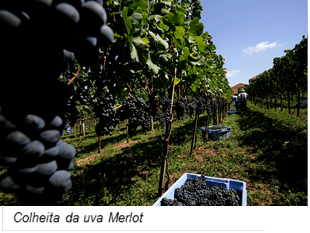
The climate in the Central Campaign was dry with very limited rainfall, which, potentiated by its sandy soil, provided long periods of drought. Temperatures at night favored the ideal ripening of grapes. The total harvest forecast is 4 million pounds.

The 2014 harvest for Miolo will go down in history as we will produce all our great wines that are made exclusively in exceptional harvests. In addition, a quality crop like this comes to crown all the work of dedication and innovation that has been realized over the years in favor of quality improvement. Now, we are going to wait for the market to recognize this and, in this way, improve the image and participation of Brazilian wines at the table of Brazilians, “said Adriano Miolo, superintendent of Miolo Group.

In the middle of March, the harvest is expected to end in the three Miolo projects in Rio Grande do Sul (this year the harvest was early) and the beginning of the harvest in the Terranova project in the São Francisco Valley (BA), which will end of 2018 with the forecast that approximately 3 million kilos of grapes will be harvested, thus totaling a harvest of 9.2 million kilos in the company’s four projects in the 2018 harvest.

In Quebec, Canada, Bourgogne wines are booming!

Figures from the Canadian monopolies for 2017 confirm the popularity of Bourgogne wines.
Exports of Bourgogne wines to Canada have been growing over the last three years and in 2017, hit record numbers with 6.5 million bottles for €50 million in revenue. Detailed analysis of sales from the three main monopoly-governed provinces, which closed their accounts at the end of March 2018, confirmed the trend.

Quebec, Ontario, and British Colombia account for at least 85% of sales of Bourgogne wines to the country. The three monopolies together recorded an 8% hike in volumes of Bourgogne wines (5.5 million bottles sold), mainly thanks to white wines, which were up 12%, compared to a 4% rise in sales of reds and a 2% for Crémant de Bourgogne.

The bulk of volume and growth involved Quebec, where the Société des Alcools du Québec (SAQ) monopoly sold 4.5 million bottles of Bourgogne wine in 2017, up 13% over 2016. This French-speaking province is the fifth-largest export market for Bourgogne wines in the world.

The Bourgogne region has profited from significant growth in white-wine drinking in the province, whilst Crémant de Bourgogne has become the leading French AOC (not including Champagne) in terms of revenue.

British Colombia continues to grow more slowly in terms of exports, up 4% in terms of volume, thanks to growth in sales of the Chablis AOC. On the other hand, sales of Bourgogne wines in Ontario have shrunk by 11% in terms of volume over the year.

Crémant de Bourgogne, sophistication and authenticity

For a long time served with crème de cassis, Crémant de Bourgogne is now establishing a reputation in its own as a high-quality sparkling wine worthy of the finest tables.
•   A relatively recent story

Sparkling Bourgogne wine first came to attention in 1830, via the plume of Alfred de Musset, who celebrated it in “Les Secrètes pensées de Raphaël”, and from the early 19th century, it was being produced in Chablis, Nuits-Saint-Georges, Rully, and Tonnerre.
The Crémant de Bourgogne appellation was created in 1975, in recognition of strict production rules, traditional and rigorous expertise, and high-quality vinification.

•   Did you know?

This wine is always white (blanc de blancs or blanc de noirs) or rosé, brut, extra brut and less often, demi-sec. The Éminent and Grand Éminent categories, introduced two years ago, are the most rigorous in terms of production. Because the ageing is so lengthy, wines bearing these labels are only now coming to market. The area covered by the appellation is the same as that of the Régionale Bourgogne appellation.

•   All the characteristics of a Bourgogne wine

For Grégory Georger, owner of the Maison Parigot & Richard, the two words that make up this appellation are significant: “The word Crémant, which is the guarantee of the production method; and the word “Bourgogne”, which takes on all its importance here because lovers of Bourgogne wines know they’re going to find all the characteristics of a Bourgogne wine – sophistication, elegance, and authenticity,” he says.

Miolo is the most awarded winery in the “Grande Prova de Vinhos 2018”

Unique winery with five championship labels in their respective categories and six more with the gold award, the brand celebrates the excellent performance

Considered to be the largest blind competition of Brazilian wines available on the market, the Grande Prova de Vinhos 2018 of Brazil enshrined and reinforced the high quality of Miolo wines in its last edition: the winery was the great winner of the competition, with six wines awarded with Gold and five champions in the categories Tinto Superpremium, Branco Sauvignon Blanc, Rosé, Tinto Outras Castas and Branco Riesling.

When Miolo presents the 2018 harvest as legendary – reissuing all its iconic labels and launching innovative wines, the winery’s performance in the Grande Prova de Vinhos 2018 is yet another validation of its excellent momentum and optimum expectation of future results.

“Critical awards such as the Grande Prova de Vinhos 2018 are the seal of the work we have been doing in recent years in improving quality and in the creation and development of new wines and sparkling wines in the four different Brazilian terroirs in which we operate,” summarizes Adriano Miolo, the group’s superintendent.

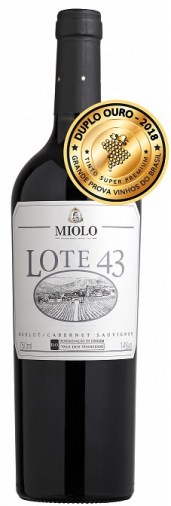
The main highlight of the achievements goes to the already recognized Miolo Lote 43, which won the Double Gold / Champion. Cultivated at the winery’s headquarters in the Vale dos Vinhedos, the wine is a tribute to the property acquired by the Italian immigrant Giuseppe Miolo in 1897, when it settled in the South of Brazil. Produced from a harmonic cut of Merlot and Cabernet Sauvignon grapes , aged in French and American oak barrels, was first produced in 1999. The Miolo Lote 43 also has an appellation of origin Vale dos Vinhedos – a great achievement in the region.

« Older Entries Recent Entries »