Sales in China increased by 25 percent, though they were still relatively limited compared to the import of French wines.
But Russia proved the most partial to an Italian glass or two, with sales there leaping 47 percent on a 12-month comparison.
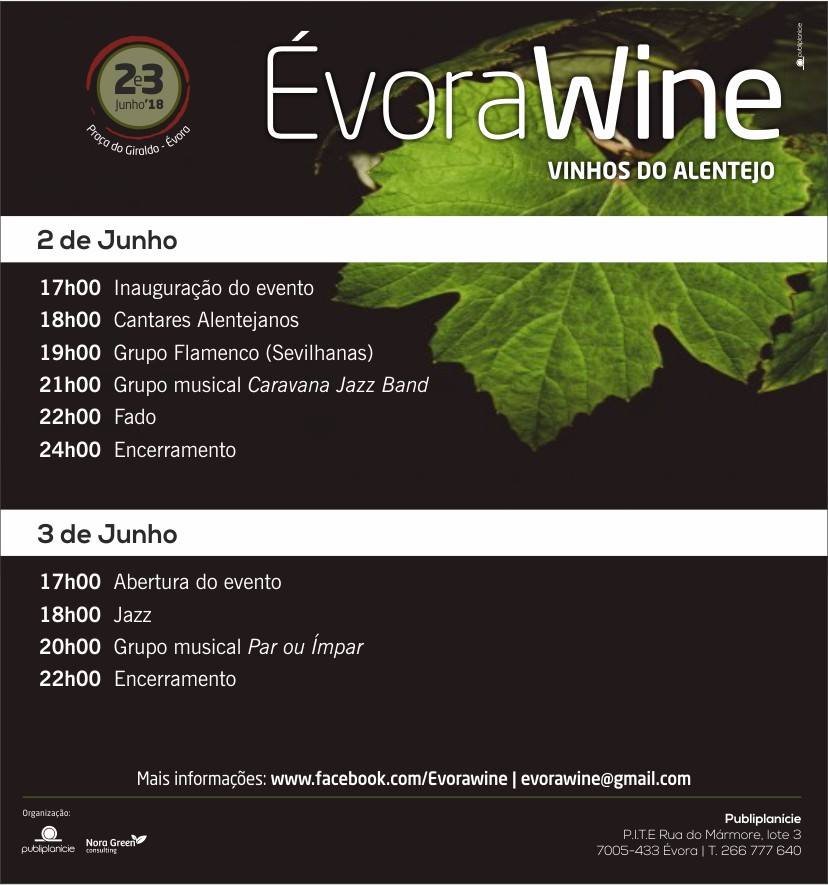
The fifth edition of ÉvoraWine, dedicated to wine lovers, is scheduled for 2 and 3 June, with the presence of 40 producers and more than 200 Alentejo wines for tasting. See here the list of wineries that will be participating.
The event, which is presented as “a true showcase for Wines of Alentejo”, will take place in Praça do Giraldo in Évora and aims to make visitors aware of the best in the Alentejo, from wines, olive oils and other regional products .
The event, according to the promoters, also helps wine producers in the region to promote the new vintages and for visitors to contact producers and winemakers and taste Wines of Alentejo.
In addition to tidbits and musical entertainment, the initiative has commented tastings, initiation courses, debates, showcookings and workshops. Check here the program for the two days.
The initiative counts on several supports, among them of the Alentejo Regional Winegrowing Commission, Regional Entity of Tourism of Alentejo and Ribatejo and Évora City Hall.
Wine buyers and market influencers came from around the world to discover the 2016 vintage and to meet growers and négociants. Some 57% of attendees were foreign visitors, representing 50 countries. The five leading nationalities were American, Italian, Belgian, Chinese and German. The remaining 43% of visitors were French.
Concerning professional activities, the event attracted importers (30%), specialist wine store representatives (21%), restaurateurs and sales agents (9%), and sommeliers (7%). Journalists accounted for 7% of visitors.
Visitors and exhibitors agreed on the quality of this edition: “Everything is done to enable visitors to discover the unique character of the Bourgogne region and its many terroirs.”
We look forward to seeing you in March 2020 for the 15th edition of the Grands Jours de Bourgogne!
We are pleased to announce the appointment of Eleonora Marconi as the new winemaker of Masseto, under the supervision of Axel Heinz, Masseto Estate Director.
Eleonora discovered her passion for wine back in high school, when she trained as a sommelier. From there she began studying for a degree in oenology at the Polytechnic University of Marche in Ancona, Italy, which led to an internship at the famed Frescobaldi Castello di Nipozzano winery and then to a full timeposition as winemaker over a period of 6 years.
born in Italy to an Italian father and Australian mother, Eleonora has a meticulous and thorough approach to winemaking and a true appreciation and respect for terroir.
In addition to her work at Nipozzano in Italy, she has garnered international experience working in the vineyards of South Australia and France.
Also, she is part of a growing number of women who are making strides in the wine business – an industry once dominated by men.
 In 1991, the purchase of a vineyard of American grapevines led to the birth of the first 15 hectares of the Cru “I Feudi di Romans”, created with a mission of consciousness and awareness to totally respect this land. Today, the Lorenzon company is considered one of the best wine-producing companies in Friuli Venezia Giulia, boasting 120 hectares of cultivated vineyards in the Isonzo DOC area.
The Lorenzon winery pays tribute to its land by transforming its best grapes into a sublime wine, expression of a unique territory dedicated to excellence. From ancient vines rediscovered “Sontium” is born, from the Latin translation of Isonzo, a new cuvée that inebriates the senses and seduces with its elegance.
The tasting
Sontium is the result of a methodical selection of the best grapes of Pinot Bianco, Friulano, Malvasia and a small part of Traminer Aromatico.
The nose is a continuous search for suggestions revealing a broad and complex bouquet with its particular spicy and ripe fruit notes. In the mouth Its charm is based on taste continuity and aromatic detail. Fluctuating in its ability to wrap the palate, it lengthens with great flavor and richness in the aftertaste.
For the food pairing this wine is ideal with starters, fish dishes and risotti.
The smallest Prosecco Consortium established in 2009 is punching above its weight: experiments on native yeasts, promotion of autochthonous varieties and wine tourism. The recently released institutional bottle is the symbol of this steady growth.
From 2013 to 2016 Asolo Prosecco Superiore DOCG has been increasing at a very fast pace, to say the least. Actually, increase has been explosive with a +569% rate, reaching in 2016 a total amount of about 8 million bottles of Asolo Prosecco Superiore. This can be explained by the fact consumers have started appreciating more and more Asolo Prosecco Superiore thanks to its intense sensory characteristics typical of hilly viticulture: freshness, minerality, fruity notes.
Altitude and constant breezes create important diurnal temperature ranges, therefore contributing to the ultimate aromatic complexity of wines and their remarkable freshness. The use of autochthonous yeasts aims at fostering even more Asolo Prosecco Superiore organoleptic identity. “When we sell a bottle of our wine we are first and foremost promoting the local region” believes Armando Serena, President of the Consortium Vini Asolo Montello. “This is why we have decided to use autochthonous yeasts for the creation of our institutional bottle. Tasting it, people will immediately remember Asolo hamlet its breath-taking views, secret passages, stunning villas”.
In the past, Asolo has opened the front gates of its villas in order to welcome personalities such as Robert Browning, Eleonora Duse and Freya Stark, Igor Stravinskij and Ernest Hemingway. It comes as no surprise that still nowadays Asolo is the third most visited town in Veneto region, after Venezia and Verona. A place full of mistery and charm that can be discovered with a glass of Asolo Prosecco Superiore DOCG.
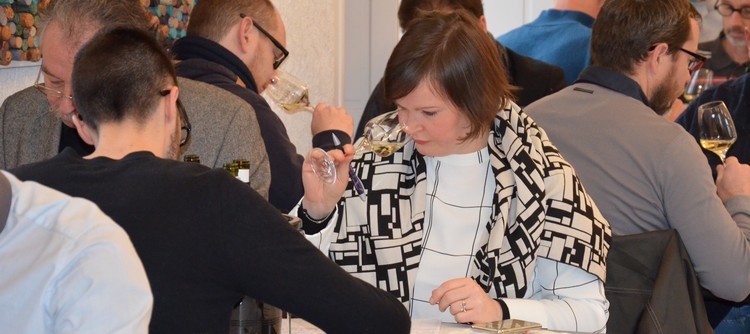 At the 32nd edition of the Chablis Wine Competition in January, 24 wines won medals, across the four appellations of Petit Chablis, Chablis, Chablis Premier Cru, and Chablis Grand Cru.
The wine is judged in two phases. The wines are first tasted by the entire jury. Those samples that obtain the best notes then go before a super-jury which alone awards the medals; gold, silver, and bronze.
The medal-winning wines are used by the Chablis arm of the BIVB during operations in France and abroad, and act as ambassadors for Chablis wines for the period of one year.
Some 272 samples are presented, with Petit Chablis, Chablis, and Chablis Premier Cru wines from the 2016 vintage and Chablis Grand Cru wines from 2015, representing 69 cellars, estates, and négociants.53
Tinazzi celebrates the creation of the new DOC appellation Pinot Grigio delle Venezie by changing the grape varieties of “Ca’ de’ Rocchi – Istà”, which now becomes 100% Pinot Grigio delle Venezie, accordingly with the guidelines of the newly created appellation.
The new DOC appellation brings together the Pinot Grigio producers of three major wine regions, Veneto, Trentino, and Friuli Venezia Giulia, and it aims at improving the quality of Pinot Grigio by decreasing the allowed production per hectare and bringing more value to the final product, which will be labelled as Pinot Grigio DOC delle Venezie.
As a result, “Ca’ de’ Rocchi – Istà” becomes 100% Pinot Grigio delle Venezie DOP, changing its style, while keeping its traditional freshness and balance between fruit and minerality.
 For more than a quarter-century, the Bourgogne Wine Board (BIVB) has been to wine tourism, and in particular through two key tools: The “De Vignes en Caves” welcome charter, created in 1991; and the “En Route vers les Bourgognes” guide.
.
The “A trip through the vines” section of the Bourgogne Wines website completes the service, enabling you to plan the perfect trip!
The “En Route vers les Bourgognes” guide was designed to facilitate planning your trip with six tourist trails through the vines. The 2018 edition lists even more producers and wine-related celebrations that ever before, proving that wine tourism is anything but a passing fad, and is a confirmed trend in the Bourgogne winegrowing region.
The 2018 guide in figures
The details of 363 estates, producers, and cooperative cellars that have signed up to the “De Vignes en Caves*” welcome charter, listing languages spoken, opening hours, price ranges, accommodation and food options, and details of organic producers.
100 wine-related events throughout the year are listed in a calendar at the end of the guide.
A map of the Bourgogne winegrowing region listing key sites to visit across the region, with smaller maps of each wine route on the back. Produced in partnership with the Bourgogne-Franche-Comté tourist board.
Sales in China increased by 25 percent, though they were still relatively limited compared to the import of French wines.
But Russia proved the most partial to an Italian glass or two, with sales there leaping 47 percent on a 12-month comparison.
 Among labels from Europe and wine-producing countries on the American continent, two sparkling wines from the Brazilian winery Miolo were elected the Best Sparkling Wine of the Americas and the Best Rosé Sparkling wine of the Americas, which reinforces Brazil’s supremacy and vocation in sparkling, consecrating the charming region of Serra Gaúcha, in the Vale dos Vinhedos (Rio Grande do Sul, Brazil), as the terroir of origin of some of the most awarded bubbles in the world.
The important awards for the sparkling Miolo Cuvée Tradition Brut (Best Sparkling Wine) and Miolo Cuvée Tradition Brut Rosé (Best Sparkling Rosé) took place in the 10th edition of the Challenge International Euposia, the only contest in the world dedicated exclusively to the bubbles elaborated by the Traditional Method, with the second fermentation of the wine inside the bottle itself. Thus, for example, champagnes are made. The event brings together some of the most important specialized critics in the world.
“It is an expressive achievement not only for Miolo, but for the market and for the image of Brazilian sparkling wine abroad. We have carried out a consistent work in international markets, promoting, communicating and divulging our sparkling wines, which have increasingly attracted attention because of its extremely high quality “, commemorates Adriano Miolo, the group’s superintendent.
The Miolo Cuvée Tradition Brut and Miolo Cuvée Tradition Brut Rosé are made in the winery’s own vineyards in the Denomination of Origin Vale dos Vinhedos. Versatile and sophisticated, they are already a subject in the international market: a lot of the Cuvée Tradition Brut has just been taken from a submerged sea basement in France, an action unheard of for a Brazilian company. And a lot of the Cuvée Tradition Brut Rosé rests, at the moment, in the same submerged basement, from where it will be removed in 2018.