Garda DOC: Natural low-alcohol wine the consortium charts a new course linking vineyards, the market and local identity
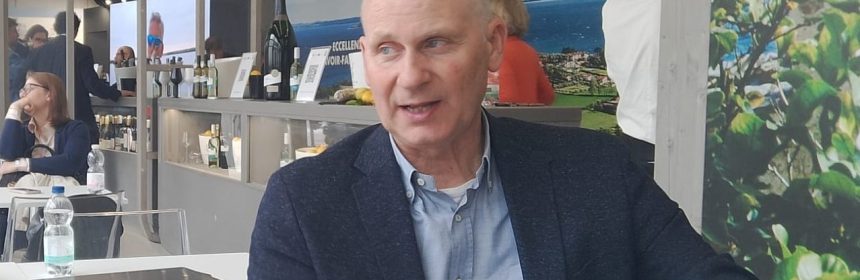
Not de-alcoholisation, but targeted harvesting and careful management of the raw material to produce 9% ABV wines. On the sidelines of Vinitaly, we spoke with Paolo Fiorini, President of the Garda DOC Consortium, about this project, which is primarily aimed at Northern European markets – with the UK at the forefront – and which will be the focus of the event on 5 June at the Garda Wine Stories Festival.
Low-alcohol from aging
In contemporary wine terminology, ‘low alcohol’ is often synonymous with subtraction: less alcohol because the alcohol is removed. In the project discussed by the consortium, however, the starting point is the opposite. The stated aim is not to produce a dealcoholised wine, but to achieve a lighter profile naturally, by working in the vineyard and on the ripening of the grapes, so as to obtain wines around 9% ABV without straying from the wine’s identity. This is the approach that emerged most strongly from the meeting, where the innovation is also linked to an update of the production regulations published in September.
The distinction is not merely technical, but cultural. In comparison, alcohol-free wines are viewed with considerable scepticism from a sensory perspective, whilst the consortium’s project presents itself as a credible alternative for those seeking a lower alcohol content without sacrificing the product’s recognisability. The heart of the operation lies, in fact, in the management of the raw material: grapes harvested with a lower sugar potential, fermentations consistent with that profile, and a winemaking process that does not involve subsequent corrective steps.
The business plan
From a commercial perspective, the reasoning is equally clear. Demand for lighter wines is said to be particularly strong in certain overseas markets, especially in the United Kingdom, where consumption trends are accompanied by tax considerations: in certain contexts, lower alcohol content also means a different tax rate. From this perspective, low-alcohol wine is not presented as a stylistic exercise, but as a response to a specific demand, already evident on the international market and set to play an increasingly significant role in production decisions.
From an oenological point of view, the project seems to tread a delicate line: preserving the link with the territory whilst at the same time making the wine more accessible, more straightforward and better suited to new drinking occasions. In this context, Garganega remains an essential reference point, despite being described as a variety that is not particularly aromatic; hence the idea of also considering blends or pairings with varieties such as Chardonnay and Pinot Grigio, to support the aromatic profile and strengthen the wine’s commercial appeal.
The result is a white wine designed for easy drinking, playing on freshness, acidity and immediacy, yet by no means lacking in gastronomic appeal.
The reference to pairings with lake fish is by no means incidental: indeed, it suggests a possible narrative for the product, which could find a coherent platform for promotion precisely in the local cuisine and the identity of the lake region. At a time when the sector is seeking new ways to speak to consumers who are less loyal to traditional categories, this aspect appears far from marginal.
The theme will be explored publicly on 5 June, during the Garda Wine Stories Festival, an annual event at which the consortium intends to focus specifically on this type of wine.
The announced approach is significant: alongside the production aspect, an economist and three journalists will be invited to analyse the positioning of low-alcohol wines in the British, German and Italian markets. This is a sign that the project is already being viewed not merely as a curiosity for the winery, but as a strategic dossier, where technique, communication and distribution must advance together.
And it is precisely the market that emerges as the true test during the meeting. There is talk of shrinking profit margins, of increasingly complex exports, of pressures linked to the geopolitical context, and of the ever-growing influence of large-scale retailers in determining the final price and the perception of value. In this context, the risk highlighted is that of a disconnect between marketing narrative and the shop shelf: a wine promoted as a quality product that then ends up on the shelf at a price incompatible with that positioning. It is a well-known issue in the sector, but here it is addressed with particular clarity, as it also directly concerns the future of low-alcohol wines.
New market trends
From a geographical perspective, the picture that emerges is quite clear: limited exposure to the United States and greater dynamism in Germany and, above all, in the United Kingdom. These are, at least according to the findings of the comparison, the markets to watch in order to gauge the project’s commercial viability. And whilst the consortium primarily claims a role of vision, coordination and synthesis amongst the companies, it is clear that the success of the operation will depend on the companies’ ability to convey that narrative to the market in a coherent manner, without it becoming diluted along the supply chain.
Climate scenario
Finally, there is one last factor, perhaps the most interesting, as it links viticulture with the climate. Fifteen years ago, producing wines of this type naturally would have been much more difficult, due to excessively high acidity. Today, however, climate change is making viable an approach that in the past seemed marginal or impractical. In other words, naturally low-alcohol wine does not arise solely from market demand: it also stems from new agronomic conditions, which are prompting regions to rethink the style, balance and language of wine.
If maintained at this level of consistency — vineyard, identity, technique, positioning — the consortium’s venture could signify something broader for Italian wine. Not merely that there is a market for lower-alcohol bottles, but that the most interesting response, at least in certain regions, may not be industrial reduction, but rather a different concept of ripeness, balance and style.
Marco Lucentini

