Chishua River: Global Fine Wines & Liquors

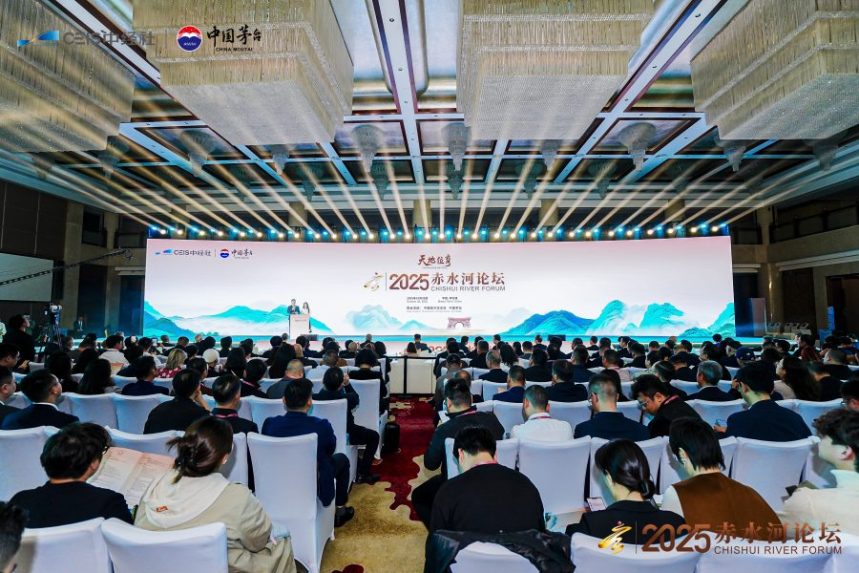
In our shared pursuit of promoting exchanges, mutual learning, coexistence and common prosperity in the global wine and liquor sector, fulfilling social responsibilities, building consensus for development, and advancing the industry’s progress, we hereby jointly issue this declaration on the banks of the Chishui River:
I. Respect nature and safeguard ecology
Respect and protect water sources, climate, raw materials and other brewing resources, adopt green and sustainable production methods, and safeguard the ecological balance.
II. Uphold quality and inherit culture
Adhere to innovation based on inheritance, improve the full-chain quality management system, achieve outstanding quality with craftsmanship, and pass on the intangible cultural heritage and classic techniques contained therein.
III. Advocate rational and healthy consumption
Strengthen public guidance, advocate moderate drinking, carry out responsible marketing, and foster a civilized, healthy and enjoyable drinking culture.
IV. Fulfill responsibilities and serve society
Integrate ESG principles into the entire development process, and contribute to a more harmonious social environment through public welfare practices and a sustainable ecological system.
V. Pursue technological empowerment and integrated development
Proactively embrace modern science and technology, advance digital-intelligent transformation, enhance product stability and style diversity, and provide consumers with high-quality and diversified options.
VI. Cultivate innovative experiences and enrich connotations
Explore the spiritual value and historical depth of drinking culture, and create drinking experiences that are ritually rich, culturally meaningful, and interactive.
VII. Foster openness, inclusiveness and mutual respect
Respect the historical origins, etiquette and brewing techniques of all alcoholic beverages around the world, honor the cultural customs of all parties, and use these drinks as a bridge to enhance understanding and jointly safeguard the rich landscape and spiritual core of global drinking culture.
VIII. Promote exchanges and mutual learning for coexistence and common prosperity
Establish a regular and diversified international dialogue mechanism, organize activities such as cross-border tastings, exchange visits, and cultural forums, promote mutual learning through exchanges, and achieve coexistence through integration.
Let’s take the Chishui River as the starting point, unite our efforts, and forge ahead with unwavering determination to jointly fulfill our commitments and create a sustainable and prosperous future for the global beverage alcohol industry.
Contribution by Prof. Andrei Chevelev on “Symbiosis between Heaven and Earth”
Across civilizations, “Heaven and Earth” have symbolized the order of nature and the destiny of humankind. To live in symbiosis with them means to recognize that human prosperity depends on ecological balance, and that our cultural traditions are themselves born from the landscapes, climates, and resources that sustain us.
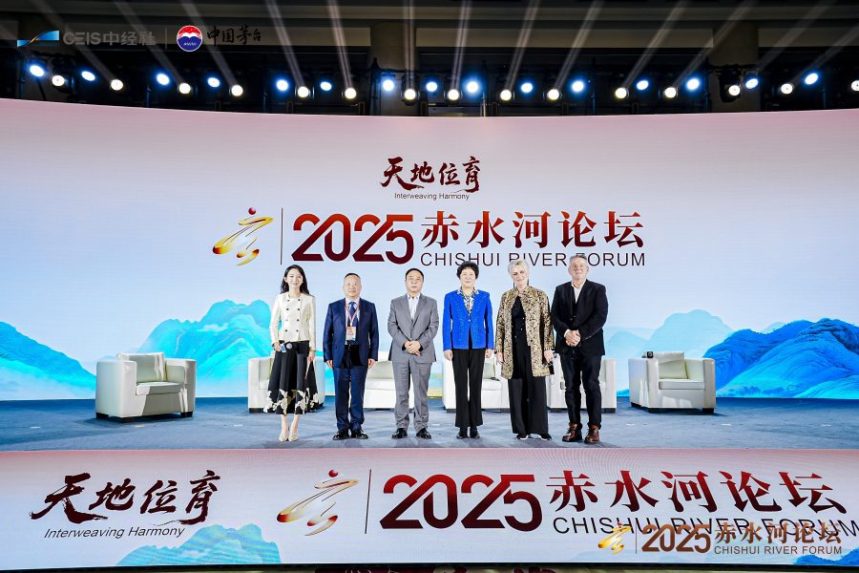
In Chinese thought, this harmony is expressed through the ideal of the unity of nature and humanity. In many ways, this concept resonates deeply with UNESCO’s vision of sustainable development and cultural diversity — that our material progress must be guided by respect for both the natural and the cultural ecosystems that nurture human creativity Looking from the West, we are convinced that the Chinese culture is firmly based on the tea. However, with all our respect for remarkable Chinese tea, we clearly understand that it would not bring together so many outstanding people far from the capital. So, the conclusion is clear- Maotai is this unique and magic instrument which has been a key to Chinese traditions and a historic window to the world.
Beyond its taste, Moutai is an emblem of harmony:
• Harmony between man and nature, through respect for natural rhythms and local ecology;
• Harmony between tradition and innovation, as ancient techniques are preserved while modern standards of sustainability are embraced;
• Harmony between people and nations, as Moutai has become a symbol of cultural dialogue — a bridge between China and the world.
In 2021, Moutai was included in the national list of intangible cultural heritage — not just as a beverage, but as a cultural ecosystem that embodies the Chinese philosophy of “Heaven–Earth–Human” unity. This idea of harmony through alcohol culture is not unique to China; it is a shared human story.
In Japan, for example, the brewing of sake follows a sacred rhythm linked to rice cultivation, water purity, and seasonal festivals. The brewers’ dedication reflects the Shinto belief that natural elements — mountains, rivers, grains — possess a divine spirit. Sake-making, therefore, becomes a form of worship — an act of gratitude to nature. UNESCO recognized this living tradition as an element of intangible cultural heritage, illustrating how ancient wisdom can guide sustainable practices even today.
In France, the wine-growing landscapes of Burgundy and Champagne tell a similar story. These regions, also recognized by UNESCO, demonstrate how generations of vintners have cultivated a landscape that balances agricultural productivity with environmental preservation. Vineyards are not only economic assets; they are cultural landscapes, living testimonies to the mutual respect between people and the earth.
These examples — from Moutai to Vodka and Sake and to French Wine — remind us that cultural heritage and sustainability are inseparable. When we protect living traditions, we also protect the environments that sustain them. When we value heritage, we encourage responsible production, ecological stewardship, and intergenerational transmission of knowledge. In the words of UNESCO, “Cultural diversity is as necessary for humankind as biodiversity is for nature.” Now, I would like to say something as a recent winner of the title “Guardian of National Culture” established by Renmin Ribao, People’s Daily.
What you are doing here, has an official name – safeguarding the Cultural Heritage.
And more precisely – Intangible Cultural Heritage. Because liquor making, especially in the case of Maotai, it is a “know-how” transmitted through generations and centuries. It is an out-of-time sign of the Chinese cultural identity. Every Chinese in every corner of our planet while tasting Maotai will remember his country, his family, his friends. Wine, whisky, cognac, vodka, or Maotai- each of them reflects a philosophy, a way of life, and a vision of beauty. This is why today’s dialogue is not simply about beverages. It is about understanding each other through what we create, through what we share.
It is about our common values.
A year ago, I was privileged to attend personally in Beijing the speech by President Xi Jinping on the occasion of the 75th anniversary of the establishment of the People’s Republic of China. The President said: “Humanity lives on the same planet, and people of all countries share a common future”. These words are exactly about what we make and what we give. This approach invites us to see traditional industries — including liquor-making — as laboratories of sustainability, where ancient knowledge and modern science can cooperate for the common good. The Moutai Forum offers precisely that: a platform where policymakers, entrepreneurs, and scholars can exchange ideas on how to integrate cultural heritage preservation into sustainable development strategies.
Imagine partnerships between the liquor-producing regions of the world — China’s Moutai town, Japan’s sake breweries, France’s vineyards — to share best practices in water conservation, renewable energy, waste reduction, and heritage education. Such initiatives would not only strengthen industries but also build a global alliance for cultural and ecological harmony. We were asked to think about the Generation Z and its specific choices. Frankly speaking, all of us are not thinking in these X, Y or Z age categories and I was surprized to know that all of my three children belong to this Generation Z.
Since then, I am trying to understand what is characteristic for them. Decoding Generation Z consumption is not just about understanding a generation. It is about decoding the next decade of growth and creativity. And this generation redefines what consumption means. Moreover, this generation Z will strongly influence the next one. The letter Z chosen for the current young generation, symbolizes an end of one tradition and a birth of another. They say that the next generation will bear the name “Alpha” and the circle will restart moving.
Born between the late 1990s and early 2010, Generation Z has grown up in a hyperconnected world: – digital, diverse, and driven by values rather than possessions. They have witnessed economic crises, climate anxiety, social activism, and the rise of authenticity as a currency. For them, drinking is not about intoxication, – it is about expression. It is social, symbolic, and increasingly selective. For previous generations, luxury meant exclusivity. For Generation Z, luxury means personal relevance. They care less about the logo on the bottle, and more about the story behind it: – the craft, the sustainability, the transparency.
As a European, I must confess: the first time I tasted Maotai, I was intrigued. It was unlike anything I had known before. It was not only a flavour – it was an experience. Behind its complex aroma, I could sense centuries of tradition, patience, and harmony. Maotai is not merely a drink – it is the embodiment of Chinese craftsmanship, philosophy and cultural pride. It reflects the Chinese belief that time, balance, and respect for nature are the essence of perfection. In Europe we also have our “spirits”: cognac from France, vodka from Russia – each born from local landscapes, climate and centuries of mastery. They too, tell stories of human creativity and connection to the land. But what unites all these traditions – East and West – is something deeper: the celebration of life, of friendship, and of the art of sharing. When we bring these traditions together – the refined precision of Maotai and the inventive artistry of Western liquors – we discover a beautiful harmony. We discover that the East and the West are not opposite, but partners in the same great human story. The President talked exactly about it. To cultivate the symbiosis between Heaven and Earth is to recognize that every drop of spirit — whether Moutai, vodka, sake or wine — carries within it a message of coexistence. It tells us that culture begins in the soil, matures in human hands, and blossoms in shared celebration. If we can preserve that harmony — between people and nature, between tradition and progress, between China and the world — then we will truly honor the legacy of Heaven and Earth. In a sense, every cultural dialogue is like distillation: through patience, respect, and openness, we create something pure.
Message of the Mongolian Ammbassador
Contribution of H.E. Sinisa Berjan, Ambassador of Bosnia and Herzegovina to China
We gather in the beautiful Maotai Town of China not only to discuss strategies for the development of the global liquor industry but also to use wine as a medium to promote dialogue between civilizations and connection between hearts and minds. On behalf of Bosnia and Herzegovina, I would like to extend our warm congratulations on the successful opening of this forum!
Bosnia and Herzegovina and China have long maintained friendly relations. In recent years, under the strategic guidance of our two heads of state, exchanges and cooperation between our two countries in the fields of politics, economy, trade, and culture have been continuously deepened. The relationship between our two countries has become a model of friendly cooperation between large and small nations and a fine example of developing countries joining hands to achieve modernization.
Wine is a common cultural language of humanity. In Bosnia and Herzegovina, we have a long tradition of wine-making and customs of warm hospitality. In China, the millennia-old liquor culture is imbued with the philosophical wisdom of “Harmony between Heaven and Man.” The theme of today’s forum, “Interweaving Harmony,” precisely encapsulates this wisdom – it advocates harmony and mutual prosperity for all things, which aligns perfectly with the pursuit of sustainable development in the global liquor industry.
Currently, the world liquor industry is facing the contemporary challenges of transformation and innovation. From ecological production to digital transformation, from cultural heritage to market expansion, we need more open vision and a more inclusive mindset. Bosnia and Herzegovina firmly believes that the diversity of civilizations is like the varieties of grapes – each flavor deserves respect, and every terroir is worth protecting. We also look forward to deepening cooperation with China and global liquor enterprises to build bridges in technology, trade, and culture.
Lastly, I would like to thank China Economic Information Service and Kweichow Moutai for initiating and organizing this forum. I also pay tribute to all friends who have contributed to cultural exchanges and industrial cooperation between China and the rest of the world. May we raise our glasses not only to savor the fine liquor but also to witness the blend of friendship and wisdom.
Contribution by Marco Leporati Managing Director Savino Del Bene Cina on The common view between China and Italy
In the past centuries the exchange between China and Italy has been continuous just few moments
- When the Roman soldiers arrived in Gansu region ans some coin has been discovered
- When Marco Polo did the long trip around China and he was surprised to find the first paper money printed in Hangzhou area.
- When the Chinese emissaries from emperor arrived in Naples and Florence around the XV Century
- In Beijing in China world art Museum in the circular room with the bas relief
- Among the most important chinese persons contribute to development of China there are Marco Polo and Matteo Ricci
- Regarding Opera the famous Opera Turandot with the music of Giacomo Puccini has some refrain took inspiration from chinese song
Also the food and beverage have some similarities.
China have 8 cuisines with a variety of thousands of dishes and a history of part of them.
The pasta or noodles, some way to cook the rice some bread like pizza make our two countries close. Regarding this issue I would like to entry more deeply in the common way to cook but unfortunately the time is limited. Italy because of the historical domination has collected a variety of dishes always related to the domination and population. In the specific topic of this conference we can observe that geographic features can offer for wine and liquor the same way to produce and to consume.
One common issue is the terroir and the same latitude. Here it is the kingdom of Moutai, drink with one thousand tears history. Italy is a kingdom of Grappa and Wine of course the row material is different: Maotai from cereals fermentation, grappa from pomace fermentation (skin seeds from grape previously used for wine production but for both products we have sou of the people. How to combine liquor, wine and fashion of lifestyle? It is possible because from my point of view we need to combine our tradition with the experiential. The last Italy-China fashion hold in Milan during the Milan fashion show in last September forging a new era of sino-italian fashion collaboration.
We know many Chinese designers and creators are using Italy like an incubator to create a new trend of fashion, also in this case, with tradition and future vision.
Confucio said:
If your plan is for one year sow the rice
If your plan is for the years plant the trees
If your plan is for 100 years educate the children
This is the path we have to walk.
 Vineyards Magazine