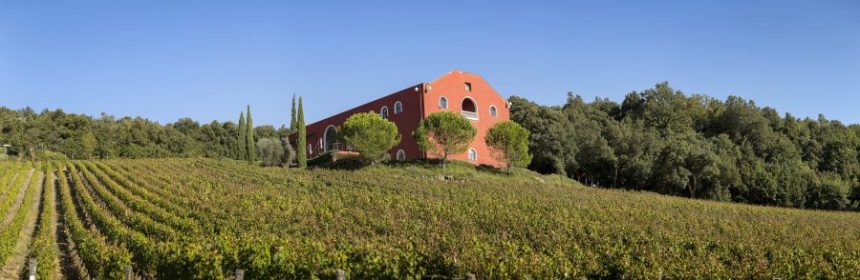
Clay, limestone, sand and volcanic formations: in Riparbella, the diversity of the terroir takes shape in the wines and inspires a philosophy founded on a balance between nature and viticulture. At Caiarossa, wine identity begins with the land. In the hills of Riparbella, just a few kilometres from the Tyrrhenian Sea, clay, limestone, sand, gravel, iron and volcanic formations alternate across a complex landscape, further shaped by differences in altitude, exposure and ventilation. It is this diversity of conditions that gives the estate one of its defining characteristics: the ability to read the different expressions of the terroir and translate them into wines with a distinct identity.
Caiarossa extends across approximately 110 hectares, including woodland, flowering meadows and olive groves, of which 40 hectares are planted with vines. The vineyards lie at altitudes ranging from 120 to 350 metres above sea level, surrounded by Mediterranean scrub and influenced by sea breezes and the characteristic light of the Tuscan coast.
The study of soil composition, microclimate and the orientation of individual vineyard sites has enabled the estate to identify 59 individual parcels, determining for each the variety, from among the 10 cultivated – six red and four white – best suited to express its potential. Each parcel is therefore monitored and managed throughout the year according to its own characteristics, without reducing its complexity to a uniform model.
The vineyards are divided into three main areas, each with its own distinctive characteristics. Podere Serra all’Olio is the historic heart of Caiarossa and home to the winery. Its soils are predominantly clay-based, with gravel, limestone and iron also present.
Further south, not far from the Cecina River, Le Lame has a different geological profile. Here, predominantly sandy and calcareous soils are exposed to breezes coming from inland.
Nocolino, on the slopes of Poggio di Nocola, reaches 350 metres above sea level and is the estate’s highest vineyard. Facing directly towards the sea and constantly ventilated, it is characterised by marl, schist and mineral-rich soils of volcanic origin.
It is precisely from the study of soil heterogeneity and the micro-parcellation of the vineyards that Caiarossa’s blending philosophy has evolved: an approach that seeks harmony and balance by bringing together the different expressions of the terroir and transforming them into wines with a strong sense of identity.
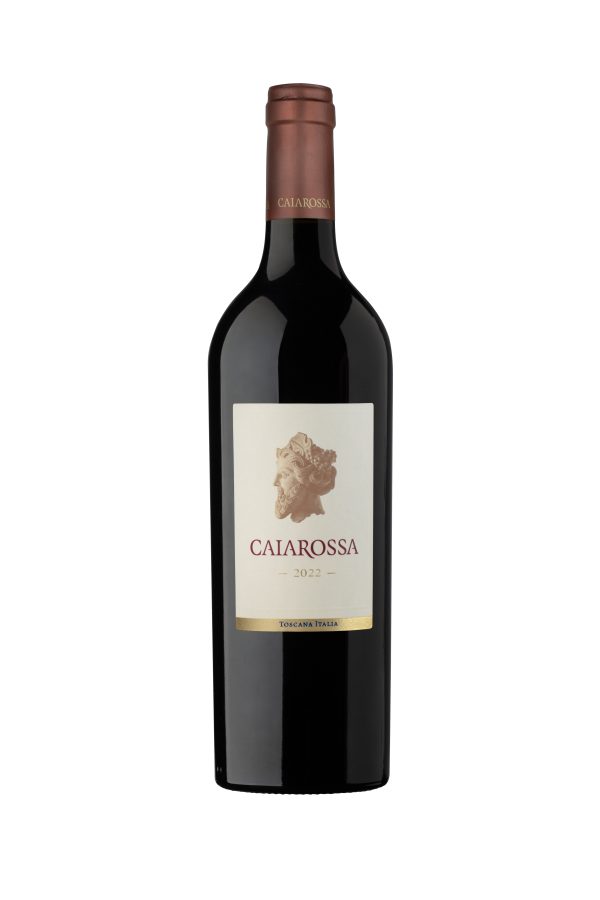
The clearest expression of this vision is Caiarossa IGT Toscana Rosso, the estate’s flagship wine, created through the blending of all the red varieties cultivated on the estate: Cabernet Franc and Syrah, together with Cabernet Sauvignon, Merlot, Sangiovese and Petit Verdot. Each variety is vinified separately and interpreted according to its specific characteristics. The diversity of grape varieties and terroirs combine to make it the broadest expression of the complexity and freshness of the Tuscan Coast. Fine, harmonious and complex in character, it is aged in barriques for at least 14 months.
Aria di Caiarossa IGT Toscana Rosso, meanwhile, focuses on the Nocolino vineyard and its Mediterranean character, with a selection of Syrah, Cabernet Sauvignon, Cabernet Franc and Merlot. The result is a wine with a velvety, deep and vibrant structure, aged for approximately 13 months in barriques, mainly second- and third-use.
Pergolaia IGT Toscana Rosso offers a contemporary interpretation of Sangiovese, Tuscany’s signature grape variety, complemented by a small proportion of Cabernet Sauvignon, Cabernet Franc and Merlot. The blend is aged for 12 months in large wooden casks. The wine combines softness, minerality and depth.
Following the same philosophy, Pergolaia Bianco IGT Toscana Bianco is made from a selection of Vermentino grapes with Chardonnay and Viognier. Fresh and vibrant, it evokes the summers of the Tuscan coast and is fermented and aged in stainless steel and concrete.
The selection of calcareous and sandy soils is showcased in Caiarossa Bianco IGT Toscana Bianco, produced in limited quantities from Chardonnay, Viognier and Vermentino. The grapes are hand-harvested in the early morning hours and gently pressed. Fermentation and ageing take place separately: Chardonnay is fermented and aged in barriques to develop depth and softness, while Viognier and Vermentino are handled in concrete or amphora to preserve their freshness and aromatic intensity. The result is a balanced, fine and mineral wine, with fruity and floral notes.
This attention to the distinctive characteristics of each terroir is also reflected during harvest. The grapes from each individual parcel are hand-harvested separately, at the point of ripeness considered ideal, and remain separate in the winery as well. The availability of fermentation vats of different sizes makes it possible to vinify each parcel individually, adapting the winemaking process to the specific characteristics of the grapes and preserving their identity through to the blending stage, when the technical team builds the final blends.
“Our work is primarily about listening: to the vineyard, the vintage, each individual parcel and each variety,” explains Francesco Villa, Technical Director at Caiarossa. “Our approach to viticulture and winemaking reflects our connection with Bordeaux culture, but here at Caiarossa it is shaped by the sea, the light and the Mediterranean climate. What we seek is balance: precision without rigidity, and expression without excess.”
Once vinification is complete, the wines are tasted and assessed to determine the individual labels, each offering a different interpretation of the estate’s vineyards and grape varieties, before following their separate ageing paths.
A plurality of identities united by a common vision: that of the Jelgersma family, which brings together close observation of the land, respect expressed through biodynamic practices, and a search for balance between people and nature, complexity and freshness, precision and naturalness.