Category Archives: Italian wines

Siddura: the virtues of heritage

Situated near the medieval, picturesque little village of Luogosanto, Siddùra can be. described as the heart of the Gallura. Here the noble culture of wine is as old as the history of the people who have inhabited this land over the centuries. To renew this antique tradition gives a historical dimension to our lives and daily toils. It fulfills our dream of creating something unique and extraordinary of these ancient roots. We are grateful for being so lucky.

The soil of the Siddura vineyards consists of a mixture of granite, sand and clay. Being loose and dry they provide the ideal conditions for viticulture, where vines give best results when suffering “hunger and thirst”. Mild temperature swings, a ventilated climate and optimal sun radiation, due to the gentle slopes, help to preserve and enhance the organoleptic character of the fruit. Our aim is to produce wines which can be closely identified with their Terroir.

Particular climatic conditions combined with soils of exceptional quantity are fundamental components of great wine. Various kinds of cultivation, meticulous supervision of the vines as well as low yields provide for unique, well-balanced and elegant wines.

The wine cellar, situated at the center of the vineyard is a subterrenean structure with natural insulation resulting from its location. Here the entire production chain takes place, starting with the grapes and ending with the bottling. We favor spontaneous fermentations and use diversified types of containers, like cement tanks, oak barrels. We regard it as our mission to respect and enhance the quality of the product, donated to us by Nature and enriched by our intellectual and professional skills.

BÀCCO

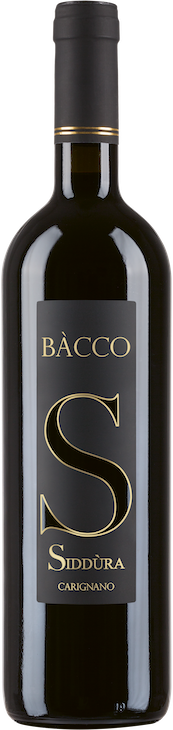
Their Carignano, comes from the most vocated area in the Region of Sardinia for this vine, introduced by the Phoenicians around the 9th century B.C. and then spread in Roman times in the south-west of the island. The wine’s taste-olfactory characteristics reflect those of the territory in which it originates, characterised by Mediterranean scrub, myrtle and strawberry bushes alternating with mastic tree and helichrysum. A dimension between heaven and earth that renders space indefinite and extends the gaze towards the horizon.

Intense ruby red, enveloping and complex, incipit of currants and berries in spirit, accompanied by sweet spices.
The palate is full-bodied, fruity and persistent, fading in an interplay between freshness and subtle tannic notes.

TÌROS

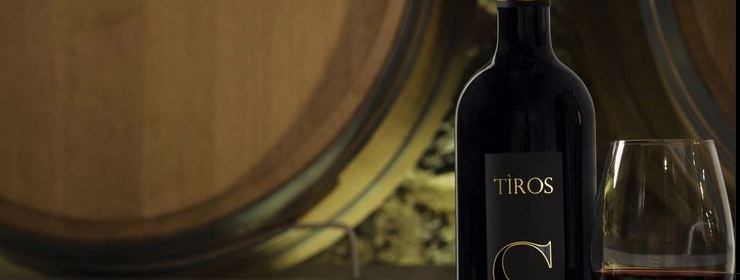
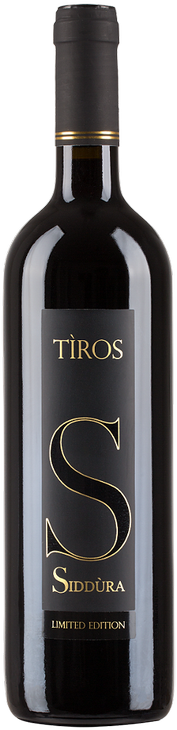
The region of Sardinia, with its unique scenery and enchanting landscapes, is not only a land for great red wines from indigenous grapes, but is now also recognised for the great value of its terroir, ideal for the cultivation of both national and international varieties, capable of producing wines of extraordinary structure and elegance, such as Tìros. Grapes that the winery processes with care to obtain a harmonious and persistent blend. An important wine for long ageing, which could not be missing to complete, with its prestige, the rich range of wines produced at Siddùra.

Intense red, fine and opulent, with a complex bouquet of spicy notes, red fruits and jammy blackberries
Full and velvety, of great elegance, with soft tannins that give pleasantness, intensity and body.

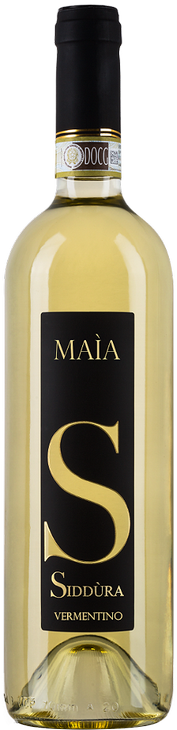
MAÌA

This is their first wine born on the estate from a careful selection of the best grapes. The particular type of soil resulting from granite disintegration, together with an optimal microclimate, have contributed to making Maìa, a Vermentino that, as its name evokes, ‘tastes of Gallura’.
Straw yellow in colour. yellow-fleshed fruit and white flowers. harmonious and delicate.
Fresh and savoury, with a good balance of flavour and a bitter almond finish typical of the variety.

Marcella Caimi

Pellegrini since 1904, quality wines and spirits

The family tradition related to wine began in the late 19th century, when Pietro Pellegrini (great-grandfather of the current owners) sold wine in his tavern at the foot of Cisano Castle. In 1904 the headquarters (still the company’s headquarters today) was built in Cisano with cellars for storing bulk wines, which was followed by the beginning of wholesale distribution in Lombardy.

The birth of the trademark “PPC – Pietro Pellegrini Cisano” dates back to that time, used to brand the estate barrels, and preserved over time as the company logo.
In the 1950s, his son Angelo (grandfather of the current generation) brought his experience to the town of Sava (Taranto), opening a branch and starting to take care of winemaking as well, with the help of his sons Gian Pietro and Emanuele.

In 1963 a farm in Montelupo Fiorentino, Florence, was purchased and a new winery built. Thus was born Fattoria di Petrognano, a winery producing wines with a strong Tuscan tradition. The wine and olive-growing business was developed and has been carried on ever since, with the same passion and dedication, by the Pellegrini family.

Inside them is a “cellar within a cellar” where the last bottles of labels that will no longer be offered for sale are placed, with the aim of building a “historical cellar” of the most important wines distributed.

WINE

Graci Etna rosso

Winery protagonist of Etna’s oenological renaissance in the name of quality and respect for identity. Located on the northern slope of the volcano, in Passopisciaro, an area of millennial winemaking tradition. The vineyards, with a density of between 6,000 and 10,000 vines per hectare, are located between 600 and 1,000 meters above sea level, part of which are planted free-range.

Only native grape varieties: Nerello Mascalese, Carricante and Catarratto. Great attention to sustainability. Cultivation of the vineyards under a certified organic regime. Very careful selections and search for full maturity by limiting yields in the vineyard to a minimum. Rigorous approach in the cellar in search of precision and finesse.

Vinification and aging take place in cement tanks, in vats and in large barrels produced with very long aging wood.
All work is aimed at indulging the personality of the vines while keeping intact the diversity and nuances between one vintage and the next, in the belief that only by indulging and respecting the natural expression of a great territory can we have wines capable of excitement.

Meme Chianti Superiore

The most widely produced wine of the Fattoria di Petrognano is Chianti in the ‘young’ type and represents 70% of the total production. Its vinification is traditional, in stainless steel, with maceration on the skins not too prolonged. After vinifying the grapes from each individual vineyard of Sangiovese and Canaiolo separately, the best containers are blended, with careful tasting. The result will form the blend of Meme Chianti docg (its name indicates the nickname given by the grandson Emanuele to his grandfather, also Emanuele).


The result is a wine for the whole meal, also excellent served chilled in summer. Exclusively in the best vintages and with part of the same lots selected, Meme Chianti Riserva docg will be aged in wood.

Elixir Pellegrini Private Stock

Barba-Turico was inspired by nineteenth-century remedies that, sold by acrobats in the squares, promised to cure everything from lovesickness to toothache. These remedies, in turn, adhered to the precepts of the Kabbalah, which provided in the number of 26 ingredients the perfect balance for the creation of an elixir of long life.

After more than a year of careful study of the laboriously recovered liquor manuals of the time, Davide Monorchio, head of the Liquors and Distillates division of Pellegrini S.p.A., analyzed hundreds of recipes and identified 26 botanicals from the Italian Alps, each known for its healing properties, to create an elixir with an “alpine” flavor.

A couple of examples? Achillea Millefoglie, in addition to being perfect for making liqueurs, was also used to treat states of anxiety and insomnia thanks to its pleasant aromatic notes. Peppermint, rich in balsamic aromas, is known in herbal treatises for its digestive virtues while Chamomile is still widely used today for its mild calming effects. Barba-Turico comes from the slow cold maceration of 26 elements including herbs, spices and roots, typical of the Italian mountains. An ancient elixir, pleasantly balsamic excellent to be enjoyed straight at the end of a meal but also served over ice.

Baffotonico is the result of the slow cold maceration of a selection of 26 berries, roots and flowers known in herbal disciplines for their stomatal and restorative virtues.
Ever faithful to the tradition of bitter elixirs, in the most literal sense of the term, Baffotonico offers itself to fans of the genre with a generous alcohol content, 33 percent vol. to maximize the aromas and flavors of all the botanical compartment used and with the addition of a very low residual sugar, the minimum necessary to create a perfect balance.

Fondo Antico, Sicilian passion

The story of Fondo Antico and the Polizzotti-Scuderi family is rooted in the pride for their origins, the passion for the tenacious and generous Sicilian land.


We are in Contrada Portelli in the territory of Trapani with the Egadi Islands majestically watching over the 80 hectares of vineyards from the sea. A hundred years’ experience in wine-growing and an obsequious respect for their origins are combined with research, innovation, team spirit and the curiosity to venture towards new horizons, to communicate their wines and make this strip of Sicily known to the world.

From 1960, half of the annual harvest was delivered to local cooperatives, while the remainder continued to be vinified on the estate. Since 1995, all production was brought back to the family winery, under the shrewd guidance of Giuseppe Polizzotti. Thus was born Fondo Antico, whose name is a tribute to the toponym by which the locals, in ancient times, used to call the land in Contrada Portelli, where it all began.

Fondo Antico’s wine production translates into the cultivation of the indigenous grape varieties of Western Sicily such as Grillo, Inzolia, Grecanico, Zibibibbo, Nero d’Avola up to Perricone. Chardonnay, Merlot, Cabernet and Syrah are the varieties that have been able to reinterpret, in an original and unrepeatable way, the richness and strength of the soils that characterise the Fondo Antico estate.

The soil

The Fondo Antico plots are planted on land of marine origin: the soil is in fact rich in calcareous deposits such as rock salt, gypsum, carbonates and sulphates, all of which contribute to making the winery’s wines more savoury and structured.


Two different altitudes and soil types characterise the Contrada Portelli vineyards: the vineyards at 350 m a.s.l. are planted on calcareous soil, which gives the wines more structure and elegance, without neglecting a good acidity base. While the other varieties are planted at 50 m a.s.l., on a medium-textured clay soil, which helps to make the wines more fresh and vigorous.

The harvest period runs from mid-August until mid-October, and the grapes are picked partly by machine and partly by hand. The company has also decided to adopt the mechanised method, in addition to the traditional one, because in a hot climate like Sicily’s, timeliness is very important. Separate vinification for each grape variety follows, thanks to the double receiving line.

The Wines

The wine production is composed of wines that reflect the personality of Fondo Antico. Thanks to the use of historical winemaking techniques in the Sicilian tradition, we obtain wines that are able to arouse emotions that only Sicily can transmit.


With this line goes in search of something more particular, more articulate, more exclusive, revealing monovarietal wines whose production technique is aimed at enhancing the varietal profile itself (colour, smell and taste).

Aitho Rosso

Etna Rosso DOC

A wine that reflects the great elegance and complexity of the volcano.
Colour: light ruby red.
Nose: red fruit aromas dominate (strawberry, black cherry) with hints of oriental spices and fresh balsamic hints that enrich the fine bouquet
Taste: harmonious and full, with silky tannins and an elegant finish.

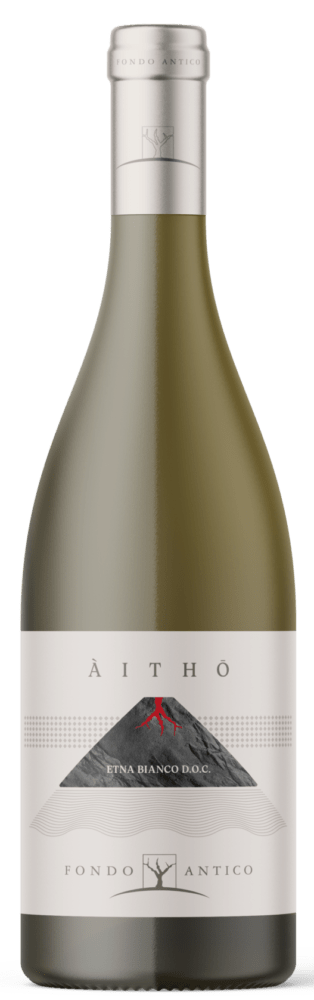
Aitho Bianco
Etna Bianco DOC


Wine kissed by the sun and sea breeze.
Colour: straw yellow with green hues.
Nose: elegant bouquet with mineral notes of gunpowder, fresh citrus hints.
Taste: dry, mineral and savoury on the palate with pleasant acidity and persistence.

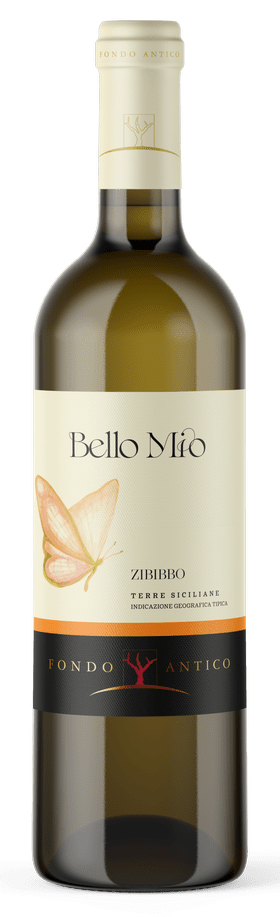
Bello mio
Zibibbo – IGT Terre Siciliane


A fragrant, captivating and delicate wine made from an indigenous aromatic variety, the Zibibibbo.
Colour: pale straw yellow with greenish reflections.
Nose: typical aromas belonging to the Terpenes family present themselves with notes of bergamot, citron, bitter orange, ending with floral notes of orange blossom, jasmine and dog rose.
Taste: The aromatic profile perceived on the nose is reconfirmed. The sip is full and savoury.

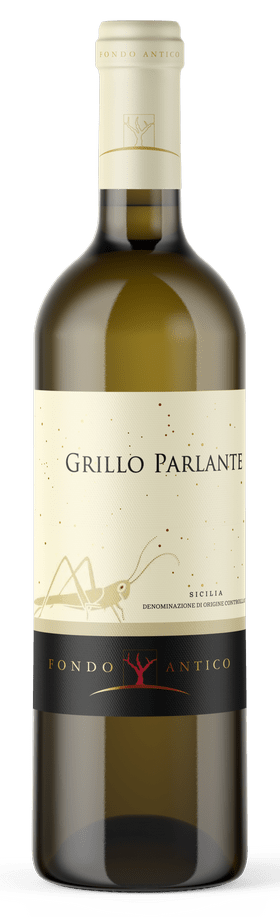
Grillo Parlante
Grillo – Sicily DOC


Brilliant straw yellow colour with greenish reflections. Its bouquet marries the exuberance of exotic fruit with the delicacy of white flowers.
Colour: brilliant, yellow with greenish reflections.
Nose: typical varietal aromas belonging to the thiol family reminiscent of exotic fruits, lychee, yellow peach, passion fruit together with more terpenic aromas reminiscent of white flowers or citrus notes.
Taste: full and fruity, balanced by the savouriness associated with the cultivation soils (carbonates and limestone of marine origin).

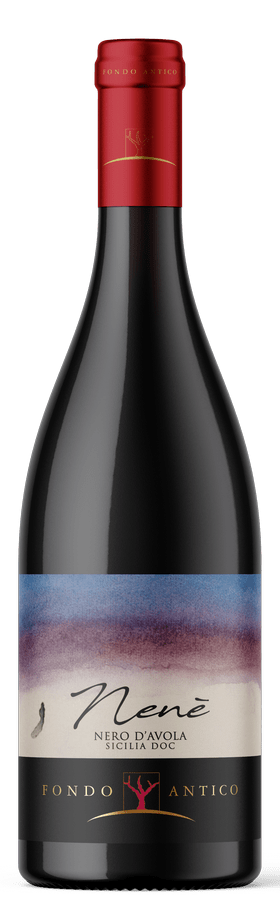
Nene’
Nero D’Avola – Sicily DOC


Nenè, to pay homage to the story “Il Mare Colore Del Vino” by Leonardo Sciascia.
A long-lived, fresh, fruity Nero d’Avola with distinct references to cherries and berries.
Colour: ruby red with violet reflections.

Nose: aromas of red fruits and cherries dominate. Dried fruits and spices enrich the fine bouquet.
Taste: harmonious and full flavours of cherry and undergrowth on the palate. The savouriness balances the roundness and makes the sip long and pleasant. It accompanies both meat and pitch dishes, especially when enriched with Mediterranean spices.

Per te
Perricone – IGT Terre Siciliane


‘Per te’ is a wine dedicated to Sicily and the Sicilian viticultural heritage, of which Perricone is an ancient expression. A vine abandoned for a long time but, with joy rediscovered.
Colour: ruby red.
Nose: the wine opens on notes of Mediterranean herbs and red fruits.
Taste: soft and enveloping on the palate, spices and Mediterranean scrub dominate the taste. Not
lacks the savouriness associated with the soils.

Rosso di Montalcino 2020. Youthful, passionate, and profoundly Biondi-Santi.

Biondi-Santi’s Rosso di Montalcino is a proud, independent-minded wine. It is an impressive combination of Sangiovese’s classic depth and texture with crisp fruit and easy drinkability, as well as the deep knowledge, prestigious growing area, and complex emotions of Tenuta Greppo, renowned for its introduction of the very first Brunello, in 1888, and today a hallowed spot for all serious wine-lovers. 

In the words of Technical Director Federico Radi, “Our Rosso di Montalcino is first of all the embodiment of fine balance, with its components of structure, acidity, and … time, all in ideal equilibrium. Even though it is a “youthful” wine, its undeniable elegance is the fruit of patience and of listening to nature, and thus it perfectly mirrors the Biondi-Santi style.  Our Sangiovese, grown in estate vineyards at elevations ranging between 200 and 550 metres, is transformed here into intriguing crispness and well-balanced tannins. This is a Rosso that is a textbook representative of its vintage.”

A mild winter and cool spring ushered in the 2020 growing season at Il Greppo. Summer rains, particularly in June, built up groundwater reserves invaluable during the hot, dry conditions of July and August, enabling the vines to maintain balanced growth and making possible an excellent suite of aromatic precursors in the grapes.  Harvest for Rosso started on September 9, right after some beneficial late-August rains. It matured 12 months in large Slavonian oak casks. 

Rosso di Montalcino DOC is the “entry key” to the world of Biondi-Santi, yet it is accessible to the wide public of wine consumers and is thus able to seduce even the youngest wine-lovers, delighting their palates with the maturity and fascination so quintessential to Brunello. 

Rosso is made exclusively from estate grown grapes and in a number of bottles that is proving unequal to a constantly-growing demand over the last three years, according to CEO Giampiero Bertolini.  A firm believer in the importance of the denomination, he describes Rosso and Brunello as “playing on the same team, both superb examples of an exceptional growing area, and that is why Bondi-Santi has such faith in Rosso di Montalcino.”

Rosso di Montalcino 2020 Biondi-Santi has been available in the markets for only a few weeks, released at three years following the harvest, about one year more than most of the denomination’s wines. Its bouquet offers a rich cornucopia of wild red berry fruit, sweet violets, and red roses, backgrounded by hints of citrus and appealing nuances of pungent balsam and wild Mediterranean herbs. The finest wine shops will be pleased to provide a couple of bottles, one to enjoy immediately, and the other to forget a few years in your wine cellar.

Masseto. The 2020 vintage, an embodiment of its time, makes a debut.

While the harvest has just came to a close in the Masseto vineyard, Masseto 2020 emerges from the estate’s cellars carved into the blue clay depths beneath the vines. Now in its 34th vintage, the iconic wine remains a coveted collector’s piece among wine lovers worldwide.

A product of the homonymous vineyard that first loaned its name to the wine and then to the estate, Masseto has since become synonymous of Italian excellence internationally. The vineyard stretches across one of the hills in Bolgheri, opposite the Tyrrhenian Sea. The few hectares are split into micro-parcels that are harvested and vinified separately.

The magic of this wine lies in the distinctive soil composition that vaunts a vein of Pliocenic blue clay once concealed in the sea, which artfully governs the hydration of the vines, absorbing excess water and keeping the roots fresh and moist, even during extended dry spells. Aligned with the Mediterranean sun and constant sea breezes, these traits form the perfect conditions for a perfect ripening of the grapes.

2020 was no exception. Typified by a mild winter, a spring with normal precipitation, and a hot, dry summer, harvest at Masseto took place in mid-September after propitious rainfall with changes in temperature from day to night. “We always picked the grapes early in the morning to preserve their freshness as much as possible and the harvest ended on 16 September,” explains Gaia Cinnirella, Winemaker and Cellar Master of Masseto. The end result once more encapsulates the essential elegance of this unique place in a glass.

Having been harvested and selected with expert care and attention, the grapes were taken to the cellar, which – as well as being an architectural gem instilled with soul-stirring geometry – was designed with the best possible conditions to turn these generous natural fruits into bottles of rare prestige.

Masseto 2020 has cultivated all the characteristics of the vintage, beginning with elegant concentration. The wine is powerful on the palate with exquisite length and balsamic notes. The integrity of the tannins reveals the hallmark ageing potential of Masseto. 

Charity auction for rare bottles of Vendemmia d’Artista Ornellaia 2020 “La Proporzione”

The online auction organised by Sotheby’s will be held from 7 to 21 September 2023. The proceeds will support the Solomon R. Guggenheim Foundationin New York, Venice and Bilbao

Organised by Sotheby’s, the annual charity auction of bottles from the 15th edition of Vendemmia d’Artista will return online from 7 to 21 September.

Double magnums, imperials and the only 9-litre salmanazar will be among the 12 lots. All the bottles are embellished with labels designed by the American artist Joseph Kosuth, who was invited to interpret this edition’s character, namely “La Proporzione” (Proportion).

The auction will provide collectors with the opportunity to secure lots of high artistic and wine significance, while doing a generous gesture. As in previous years since 2019, all profits will go to the Solomon R. Guggenheim Foundation’s “Mind’s Eye” program, which welcomes and enhances access to the arts for visitors who are blind or have low vision. “We are proud to support this initiative,” comments Giovanni Geddes da Filicaja, CEO of Ornellaia. “Like in art, appreciation of fine wines requires total involvement of the senses. Furthermore, for us, partnering with the Guggenheim Foundation is a way of giving back to the community some of the extraordinary goodwill that nature has bestowed upon us.” These unique bottles are precious for three reasons: their contents, their works of art on the labels and, last but not least, their goal of increasing access to the arts for all visitors.

In 2020, nature and humanity combined to craft a perfect ‘proportion’ of elegance, power and complexity. In order to interpret this correspondence, the leading American conceptual artist and theorist Joseph Kosuth created a set of works based on the word “wine” and a quote from Vitruvius’s De Architectura (3.1.3). The 750ml bottle features the English version of the phrase engraved on the paper. For the 100 double magnums, the etymology of the word “wine” is embossed on the bottle, while each of the unique 10 imperials sees the etymology engraved onto the glass. One branch is accentuated in white and the quote from Vitruvius is translated in the highlighted language or one of its modern descendants: Albanian, Serbo-Croatian, Latin, Italian, Hindi, Hebrew, Modern Greek, Irish, German and Armenian. For the salmanazar, the etymology and quote from Vitruvius below are in English and the highlighting applied to the bottle is in platinum.

Joseph Kosuth: “I believe that language is an important part of experiencing everything and that these experiences shape us in a certain way linguistically. The architecture of experience through language was obviously always at work and I believe that Vitruvius was a major resource in understanding a concept like proportion. Proportion is not only visible equilibrium among the elements, but also equilibrium of all the elements that make it a perfect entity of what it represents for the world, thus also shaping it as conception.”

125 Years of Castello di Querceto

La Corte 2019: Interpreter of the past and present

The origins of Castello di Querceto, with its crenellated tower, date back to the Middle Ages, but the milestone being celebrated by the François family this year is an impressive 125 years as wine producers.

It was in 1897, in fact, in Dudda, in the commune of Greve in Chianti, that Carlo François purchased Castello di Querceto. Even then, estate-grown wine was being made within its venerable cellars from the surrounding vineyards, and Carlo, immediately recognising the innate quality of its Sangiovese, began to make a monovarietal from a small vineyard parcel of particular promise. That was the ancestor of La Corte, and a few bottles, dated 1904, still survive. A few years later, in 1924, Castello di Querceto became a founding producer of the Consorzio Chianti Classico.

The estate’s modern history, however, begins with Alessandro François, and his pioneering concept of the Chianti Classico cru. Since the 1970s, he has been minutely studying every individual plot on the estate, and, confirming the ground-breaking intuitions of his grandfather, he determined that the qualities of that very same parcel merited his first single-vineyard wine. La Corte thus debuted officially in 1978 as an IGT Toscana, produced from that 3.4-hectare vineyard lying at an elevation of 450 metres, planted with a south-southwest-facing exposure in sandy soils.     

Over the following decades, other singular expressions enriched the collection, and Castello di Querceto became a benchmark for the entire denomination, a growing area for which Alessandro and his wife Antonietta have been ambassadors literally across five continents, exporting their wines to over 50 countries. Today, Simone and Lia François work side by side with their father in managing the wine estate, as do their respective spouses Stefania and Marco, sharing responsibility for hospitality, administration, and export. 

Over the years, research at the Castello has proceeded uninterrupted. The introduction of precision viticulture has proved decisive, as well as minimal intervention in the winemaking process; both testify to the philosophy of striving to highlight the distinctive characteristics of each individual vineyard parcel. 

The historic La Corte cru fully embodies this approach. With the 2017 vintage, it became a Chianti Classico Gran Selezione, thus joining the other prestigious cru, Il Picchio, which has been a Gran Selezione since 2011. “Both of these Sangiovese wines have always so impressed us that they deserved to bear the denomination’s highest quality designation,” commented Simone François.

“At 125 years from the founding of Castello di Querceto,” added Alessandro François, “La Corte continues to gift us a vibrant, comprehensive, and eloquent expression of our terroir. It amply demonstrates the incredible qualities of this growing area, as well as of the denomination that we are so proud to be a part of.”

Chianti Classico Gran Selezione La Corte 2019, released just recently on the market, is the fruit of a growing season which proved well-balanced and of impressive quality. Generous rainfall in the spring filled groundwater reserves that helped the vines cope with a dry summer. The heat was not excessive, however, thanks to Castello di Querceto’s elevation and to significant day-night temperature differences. Finally, very favourable weather in September and October allowed the winery to push back the start of harvest. The results were ideally-ripe clusters that yielded a taught, clean-edged, pleasurable Sangiovese.    

“All in all, a perfect vintage for our celebration of such an important anniversary,” concluded Simone François, fourth generation of a family fiercely proud of its traditions, and one whose long history gives it the ability to see far into its future.

*

The winery, along with its agriturism and luxuriant park, lies in Dudda, in a small valley in the hills high above Greve, in north-central Tuscany. Here, the François family grow their wines in some 65 hectares of estate vineyards, subdivided into 26 individual parcels planted in Cretaceous-Eocene polychrome schists. In addition to the Chianti Classico line, led by the two Gran Selezione crus, La Corte and Il Picchio, the portfolio boasts various IGT crus, Il Cignale, Il Querciolaia, Il Sole di Alessandro (Cabernet Sauvignon), and QueRceto Romantic, an elegant blend of Petit Verdot, Merlot, and Syrah.

Citizenship in the contemporary world and responsibility to the local environment and to future generations require a commitment to sustainability, and thus Castello di Querceto has been a certified participant in the Italian government’s ViVa program since 2022.    

Henry Borzi

Vintage 2022 a year of contradicting weather: the winemakers display versatility and resilience to achieve an expression of the finest quality

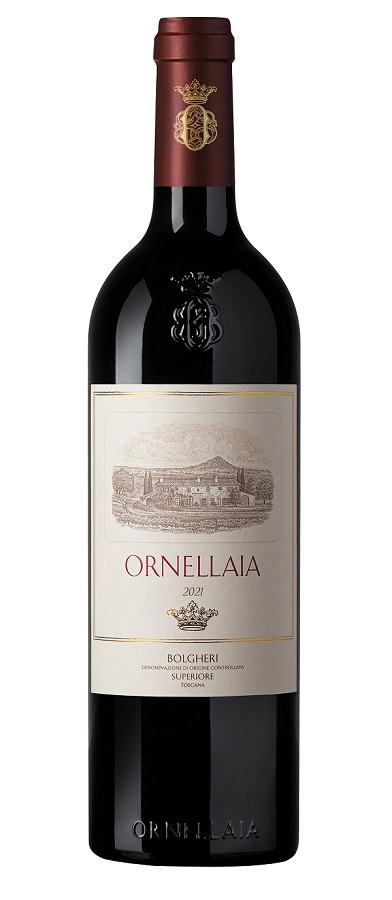
The 2022 harvest has ended and now we can review a year of unusual weather contradictions. Axel Heinz, Ornellaia’s Estate Director, describes the vintage as a continual challenge that required the expressive abilities of mankind to adapt to the working processes. A vintage that was always on the edge, where disaster was constantly on the horizon, but where in the end various weather events balanced out the negative effects, enabling the winemakers to find a nuanced expression of the finest quality through mental nimbleness and resilience.”

A climatic analysis shows how the 2022 vintage began as usual without prognosticating any issues, with winter temperatures within the norm and a cool spring with a slightly delayed budbreak on the vines. The conditions inverted in May, with temperatures exceeding 30°C and a dearth of rain for 75 consecutive days, truly testing the growth, flowering and veraison of the vines.

The harvest started early on 9 August with the first bunches of Sauvignon Blanc, but was immediately interrupted by the arrival of the much-awaited summer storms, which again disrupted the conditions that had distinguished the year thus far. The abundant rainfall instigated a turning point, eliminating the water stress and reactivating the ripening process. A cool and sunny September brought near-perfect conditions to ripen the Cabernet Franc and Cabernet Sauvignon.

Interpreting the unusual weather contradictions in the vineyard and in the cellar required certain measures to achieve a fine expression, such as night harvesting of the earliest white grapes in order to preserve the freshness and aromas; the use of a refrigerating room to keep the temperature of the grapes low; and the meticulous discarding of dried grapes as well as ones that had remained green after the veraison. Experimentation on the winemaking front also occurred with the addition of the use of amphorae alongside barriques and tonneaux.

“The hallmark of a hot vintage is clear in the wines,” explains Axel Heinz. “The wines are ample and bodied, yet balanced by a beautiful acidity and precise aromas. The Sauvignon Blanc shows its exotic side with tropical fruit aromas, while the Viognier and Vermentino display prolonged floral notes. Less concentrated than usual and struggling to free the skin content, the Merlot required longer static maceration to obtain an enjoyable density, doing away with rustic tannins. On the contrary, the Cabernets demonstrated deep and layered hues, even in the first few days of maceration, developing a traditional aromatic profile with signature notes of cassis for the Cabernet Sauvignon and spiced violet nuances for the Cabernet Franc. The aromatic freshness is surprising, dotted with menthol and balsamic overtones, as well as plush tannins, all of which provide an exceptional basis for long, harmonious ageing.

Now comes the final challenge of 2022: “The blending, when we will need to find the right balance between the various parts to express the many virtues that 2022 yielded to those who listened to nature with respect and dedication through the struggles,” concludes Axel Heinz.

Michele Zanardi

ORNELLAIA VENDEMMIA D’ARTISTA

“Il Vigore” 2019

THE ONLINE FINE WINE AUCTION HAS FINISHED.

DESIGNED BY ARTISTS NATHALIE DJURBERG AND HANS BERG, THE FINAL AMOUNT RAISED WAS

$ 302,000

All the profits have been given to the Solomon R. Guggenheim Foundation for the Mind’s Eye program.

The online auction of Vendemmia d’Artista 2019: Il Vigore, hosted by Sotheby’s, finished yesterday. The fine bottles of wine, which were designed this year by Swedish artists Nathalie Djurberg and Hans Berg, were allocated to art and wine collectors, raising a final amount of $ 302,000. The profits from the auction will be given to the Solomon R. Guggenheim Foundation to further the important endeavours of the Mind’s Eye program.

On announcing the results of the auction for this fourteenth edition of Vendemmia d’Artista, the CEO of Ornellaia, Giovanni Geddes da Filicaja, communicated his pleasure of having renewed the partnership with the Guggenheim Museum for another three years. “We are very enthusiastic about continuing to support the development of this special project that we believe in. Since the beginning, we wanted Mind’s Eye to be able to develop and become available to a vast audience from different places around the world. This global vision has now developed even more, ensuring that the program has become a feature of all the Guggenheim museums, in New York, Venice and Bilbao.”

Mind’s Eye is more than a mere experience; it is a set of tools capable of broadening accessibility to art through the use of the senses. As Richard Armstrong, Director of Solomon R. Guggenheim Foundation and Museum, explains: “With Ornellaia’s continued support, we will expand the Mind’s Eye programs to a global audience with a focus on developing the verbal descriptions in all our museums. Next year, we will produce content for the Peggy Guggenheim Collection with translations in several languages. Furthermore, we will continue the events in New York and the online programs, which will be available internationally. Looking towards 2023, thanks to the auction profits, we will concentrate on creating Mind’s Eye content for the Guggenheim Museum Bilbao. These projects will continue in 2024 to expand the program, increasing the resources and the audience.”

Wine, like art, transcends words and, through the senses, the use of an emotional language takes on a universal value. The interpretation of the vintage was entrusted to the creativity of Swedish artists Nathalie Djurberg and Hans Berg. The themes of metamorphosis and the constantly evolving cycles of nature and its driving force form the core of the work, providing the perfect canvas for the artists of the fourteenth edition of Vendemmia d’Artista to interpret the theme of “Vigore” through art. The precious lots provided for the auction included 9 six-litre Imperial and the only nine-litre Salmanazar of Ornellaia Vendemmia d’Artista 2019, whereby the evolution of the concept of the relationship between humans and the earth is expressed through the sculptures.

Nittardi, 40 years of wine and art

From 10 to 30 November 2022… in homage to Chianti Classico Casanuova di Nittardi Vigna Doghessa, the Nittardi collection will be on display at the Galleria Palazzo Coveri of Florence: over 80 works by the most important contemporary artists.

Casanuova di Nittardi is the historic Chianti Classico of Nittardi winery. Its very first vintage saw the launch of an art project, which has now, with the wine’s 2020 vintage, reached its 40th anniversary. Since 1981, the Canali-Femfert family has been celebrating the character and history of Casanuova di Nittardi by means of a unique artwork series: for each vintage, artists are invited to create two art pieces, one for the bottle label and one for its wrapping paper.

To celebrate this particular milestone, the Canali-Femfert family decided to establish an international art competition – the Premio Nittardi. Its prestigious jury has selected not one, but six artists, since the guiding concept is to offer passionate collectors of Nittardi an unpredecented case of six bottles of Chianti Classico Casanuova di Nittardi Vigna Doghessa 2020, each with a different label and wrapping paper.

This one-of-a-kind eno-artistic treasure, the Collezione Nittardi, from 10 to 30 November 2022, moves to Florence’s Galleria di Palazzo Coveri, at 19 Lungarno Giucciardini, where visitors may admire both the original art works as well as the entire set of bottles with their front labels and wrapping paper.

This journey through 40 vintages of a wine that is itself an artwork offers the rare opportunity to appreciate some of the most influential figures of contemporary international art, and in doing so has created a further artistic dimension… for all the senses.

Over the years, Chianti Classico Casanuova di Nittardi Vigna Doghessa has proudly borne the signatures and artworks of international artists such as Pierre Alechinsky, Corneille, Dario Fo, Karl Otto Götz, Günter Grass, Friedensreich Hundertwasser, Yoko Ono, Mimmo Paladino, Fabrizio Plessi, Mikis Theodorakis and many others. They are joined today by this year’s winners of the Premio Nittardi: Italian artists Chiara Mazzotti and Fausto Maria Franchi, and from abroad, Pengpeng Wang, Ulrike Seyboth, Olle Borg, and Andreas Floudas-Zygouras. In addition, the Femfert family also selected a seventh artist, Roberto Maria Lino, to artistically dress the Magnums.

***

The exhibition _ The public may visit the exhibition in the Galleria Palazzo Coveri, at Lungarno Giucciardini 19, in Florence from 10 to 30 November 2022, Tuesday through Saturday, from 11.00am to 1.00pm and from 3.30pm to 7.00pm. Entry is free.

The Premio Nittardi jury _ The Premio Nittardi jury is composed of Luigi Toninelli (Gallerista of Milan/Monte Carlo), Johannes Heisig (German author and artist of an art piece for the 2019 vintage), Amy Ernst (artist, niece of Max Ernst), Anthony von Mandl (Canadian art collector and wine producer), Young Ho Kim (Korean art collector), Gianna Martini Coveri (CEO, Gruppo Coveri).

Winners of the Premio Nittardi _ Chiara Mazzotti (I) with “Purezza concreta” and “Celebrazione”; Fausto Maria Franchi (I) with “Capriccio italiano”; Pengpeng Wang (CHINA) with “Pensieri”; Ulrike Seyboth (D) with “fructueux” and “abondance”; Olle Borg (S) with “Sine Nomine”; and Andreas Floudas-Zygouras (GR) with “Per Edoardo” and “Wine stages”. Special prize awarded to Roberto Maria Lino (I) by the Femfert family, for the Magnum label and for his works “Sutura”.

The Nittardi Collection _ The artists who have created labels and wrapping papers to date are Bruno Bruni (1981), Maurilio Minuzzi (1982), Karl Korab (1983), Simon Dittrich (1984), Miguel Berrocal (1985), Alfred Hrdlicka (1986), Paul Wunderlich (1987), Rudolf Hausner (1988), Friedensreich Hundertwasser (1989), Horst Janssen (1990), Valerio Adami (1991), Corneille (1992), A.R. Penck (1993), Eduardo Arroyo (1994), Raymond E. Waydelich (1995), Luigi Veronesi (1996), Igor Mitoraj (1997), Elvira Bach (1998), Emilio Tadini (1999), Sandra Brandeis Crawford (2000), Volker Stelzmann (2001), Giuliano Ghelli (2002), Robert Combas (2003), Klaus Zylla (2004), Yoko Ono (2005), Mimmo Paladino (2006), Tomi Ungerer (2007), Günter Grass (2008), Pierre Alechinsky (2009), Dario Fo (2010), Kim Tschang Yeul (2011), Karl Otto Goetz (2012), Alain Clément (2013), Hsiao Chin (2014), Joe Tilson (2015), Allen Jones (2016), Mikis Theodorakis (2017) Johannes Heisig (2018) and Fabrizio Plessi (2019).

The wine _ Chianti Classico Casanuova di Nittardi is grown near the villa residence in Castellina in Chianti and, since 2012, has been the offspring of a single vineyard, Vigna Doghessa. This parcel, lying at 450 metres above sea level with superlative southern exposure, has soil of medium depth, rich in galestro and alberese, two geological materials that define the character of our Chianti Classico. The wine is as unique as it is complex, just as a work of art can be.

The winery _ Nittardi has 40 hectares of vineyards, organically formed since 2014, divided between Castellina in Chianti and Maremma in Tuscany. In the sixteenth century, the estate was owned̀ by Michelangelo, who would send wine from there to Rome as a present for Pope Paul III. Art and creativity are in the DNA of the estate, as evidenced by the extraordinary park of contemporary sculptures and the exceptional artists who, every year since 1981, have created two works dedicated to the historic Chianti Classico Casanuova di Nittardi at the invitation of the curator Peter Femfert; his wife Stefania Canali, historian; and their eldest son Léon, who has managed the estate since 2013.

« Older Entries Recent Entries »